Showing posts with label six pack. Show all posts

Sunday, 7 February 2016

How to Get 6-Pack Abs

Every bodybuilding expert agrees that diet is the number one way to get rid of subcutaneous fat and show off your muscles, particularly your abdominals. But not every expert agrees on how to get 6-pack abs.
Almost all the experts have built the abdominals we all desire. How you build yours is a matter of choosing which method works best for your body configuration and metabolism.


Crunchies and diet
Let’s start with the late, great Vince Gironda, aka The Iron Guru. He advocated avoiding sit-ups completely. Vince had a 6-pack of abs like no one else of his era (his was more like an 8-pack!). He trained hundreds of bodybuilding champions and a host of other body-beautiful celebs, including movie stars and action movie heroes.

For abs, Vince recommended a series of crunching exercises; on the mat, hanging from a pull-up bar, on a bench and using the Roman chair. He also maintained that it was your diet that displayed your abs, not your workout routine. Vince was very controversial, but he was also a very successful trainer.

Work everything
Four-time Mr. Universe winner, Bill Pearl has written what is arguably the very best book on weight training and bodybuilding ever composed. In his Keys to the Inner Universe, Bill has 62 pages on abdominal work covering more than 240 different exercises and variations of exercises.
Bill Pearl’s abs looked like the Rocky Mountains divided by the Grand Canyon. At the age of 47 he was voted the “best built man in the World,” by his contemporaries.


Who is right?
Actually, they both are. Gironda believed in working the abdominals sufficiently and correctly to develop them and then dieting properly to show them off. Pearl believed in building every muscle to its maximum potential and then dieting to get rid of the body fat so they would show well.

Vince Gironda was small of stature, very muscular, fit and trim. Bill Pearl was exactly the opposite: moderately tall, massively muscled, extremely defined and very fit. Both of their students emulated Pearl’s build as much as they could.

Today we can learn from both of these champions and trainers of champions, and combine their techniques to get the ultimate guide for 6-pack abs.


Perform three sets of each of these exercises

   Roman Chair Sit-Ups – This is a backless chair device that allows you to hook your legs under a rung and then perform sit-ups for abs and back-bends for lower back muscles.
   Incline Board Crunches – A partial sit-up where you raise your head and shoulders while contracting your abs forcefully.
   • Supine Crunches –On a bench or mat, elevate your legs with them bent at a 90 degree angle and place your hands behind your head. Crunch your abs while touching your left elbow to right knee and the reverse.
   Dumbbell Side-Bends – Seated or standing and using a single dumbbell, lower the weight at arm’s length and then return to upright. Alternate sides with 20 reps each side. This is also performed with the weight hanging behind your buttocks so you pull the rear obliques.
   Pull-Up Bar Leg Raises – With your hands widely placed on the chinning bar, slowly elevate your legs, bring your knees to your chest. Lower and repeat.
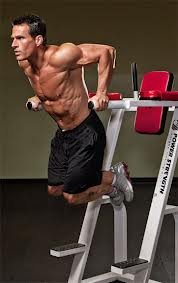
   Parallel Bar Dip Machine Knee-Ups – With your forearms resting on each side of the dip bar, elevate your knees to waist level.

 This completes your 6-pack ab workout!

Monday, 25 January 2016

Bodybuilding Chest Workout

The chest muscle group, the pectoralis major, is the largest muscle group in the upper body. As such, the chest requires a great many very specific exercises to work the upper, lower and inner pecs. A good looking chest really sets off the appearance of a physique.


Even beginning bodybuilders are aware that in order to build muscle, you have to tear it down with exercise and rebuild it with a high-protein diet. A bodybuilding diet should be at least 25% protein and 40% natural, unrefined carbohydrates, with the balance being in fats and fibers.

The bodybuilding chest workout should be the total focus of one workout per week. Other muscles will get worked in this routine, but only as incidental to the chest exercises. The exercises will involve barbells, dumbbells and body-resistance moves.

The exercises should be performed in the order of descending strength of the muscle parts. In other words, begin with the exercise for which you use the heaviest poundage. Then work down the ladder from there.

Most chest bodybuilding exercises will be three sets of eight to ten repetitions each for an intermediate level bodybuilder. An advanced exerciser should consider raising that to five sets of six to eight reps with heavier weights.


Bench Press, with Barbell, Wide-grip
Lie flat on the bench with your feet planted flat and squarely on the floor. Grip the bar at about double shoulder width. Lower the barbell to your upper chest-lower neck region, pause, and return to overhead.

Begin with a one set as a warm-up with a moderate weight. Perform the next sets with the maximum weight you can handle for eight to ten repetitions.
Make each movement slow and smooth and pause at full contraction. Do not bounce the weight on your chest. Do not arch your back or lift your buttocks off the bench as this will place strain on you lower neck and could cause injury.


Front Barbell Raise, Incline
Using an incline bench and a lighter weight barbell, begin with the barbell grasped palms down and your arms facing straight down. Raise the weight smoothly overhead, continuing until your arms are extended behind your head.


Dumbbell Flies, Flat Bench
Using two moderately heavy dumbbells and lying supine, begin with the dumbbells held straight up. Lower them smoothly while bending your arms slightly at the elbow. The finish point should be with your arms parallel with the floor. Don’t hyperextend your shoulder joints.


Incline Press with Barbell, Wide-Grip
Using an incline bench, begin with the barbell straight overhead. Lower the weight to your upper chest-lower neck area. Use a weight that exhausts your muscles at eight to ten reps.


Decline Press with Barbell, Wide-Grip
Using a decline bench, begin with your arms perpendicular to the floor. Lower the weight slowly to the neck and perform eight to ten reps.


Flat Bench Dumbbell Press
 Begin the move with the dumbbells straight overhead and then lower them to your chest keeping your elbows high and your upper arm nearly parallel with your shoulders. Use heavy dumbbells for eight to ten reps.


Flat Bench Dumbbell Pullover Press Lateral
Using medium weight dumbbells and beginning the move with the weights at your chest, rotate the dumbbells past your head towards the floor. In one movement, bring them back to your chest and press them overhead and then immediately perform a lateral fly with your arms bent at a forty-five degree angle.


Push-Ups Hands Together
 Assume the push-up position with your body straight and up on your toes with your hands about a foot apart. Perform push-ups slowly for as many reps as you are able.
And that completes your chest workout. Bring on those ripped chest muscles!

Sunday, 17 January 2016

Bodybuilding Diet

“Bodybuilding is 80% diet.” This statement was uttered many years ago by one of the greatest bodybuilding trainers of his era, Vince Gironda.


With some fame as a bodybuilder himself, “The Iron Guru,” as he became known, was more famous for helping a newcomer to the USA, Arnold Schwartzenegger move rapidly up the road to become one of the greatest bodybuilders of all time.

His acolytes list reads like a who’s who in bodybuilding of the 1950s through 1997.
Vince was convinced that a bodybuilding diet was the key to muscle-building success, and he was fundamental in convincing other people of this principle in his multi-decade career as a trainer of champions.


In a nutshell, a bodybuilding diet should focus on the best useable sources of protein, natural carbohydrates in the form of fresh vegetables and fruits, fats and oils, and finally, nuts. Bodybuilders also need to include supplements that help grow muscle tissue and reduce the subcutaneous fat on the body.

Renowned biologist, Bernard Beverley, stated that human tissue is 100% biological. What that means for bodybuilders is that eating foods that are very high in biological content is very important for developing that tissue as far as possible. Lots of people confuse foods high in biological content with foods high in protein, but this isn’t entirely the case as not all protein is the same. Biological content means food that contains protein of a structure that is very similar to the protein contained in human tissue.

This might come as a surprise to some, but the food with the highest biological content is the humble egg! Other foods high in biological content include raw milk, organ meats (heart, liver, kidneys and sweetbreads), steak, lamb, poultry and fish. Beans, legumes and some other vegetables are also good sources of protein, so it’s really important to include them in your diet as well.


On the other hand, soybeans, although famously high in protein, are only 22% biological. Thus you would have to eat huge amounts of soy to equal the amino acid content of the higher quality protein previously listed. For contest preparation, the Iron Guru recommended avoiding anabolic steroids in favor of eating as many as three dozen eggs per day!

The idea is that this gives your muscles a huge influx of biological protein so that they can reach new levels of strength and quickly repair any damage. After six to eight weeks, you should then reduce this amount to one or two per day, as you would have achieved your goal.


On the other hand, other bodybuilding diets focus on red meat and fresh vegetables, or one high in dairy products and fish. Each of these approaches serves a particular goal, that of loading the system with protein to replace and rebuild muscle tissue torn down by heavy workout sessions. They are not long-term diet plans however. Bodybuilding supplements that Gironda recommended were: Kelp tablets, desiccated liver, lipotropic amino acids(inositol, choline, methionine, betain that aid in the metabolism and assimilation of protein) and wheat germ oil. Another diet method the Iron Guru developed was putting his students on a special bodybuilding diet cycle in preparation for contests, to get rid of that last bit of subcutaneous fat.

This was composed of four days of zero carbohydrates, then on the fifth day eat normally. For the next four days eat zero carbs, and on the tenth day eat normally. The students would keep this up for between three and eight weeks, until every muscle separation and vein popped out on the surface.
 

In summary, a good bodybuilding diet should be focused on protein, fats, good carbohydrates and fiber. The breakdown should be 24% protein, 40% natural carbs (no refined starches or sugars) and the balance in fat and fiber.
Just before competition diets, and cycling of zero carbs for four days and the fifth day free, should be followed for no more than eight weeks. Appropriate supplements should be taken.

Tuesday, 29 December 2015

Best Chest Workout


The pectoralis major is the largest muscle group in the upper body. The chest muscles are large slabs spread across the upper torso, so the best chest workout is achieved by using heavy weights in a number of exercises that focus on the upper, lower, inner and outer pecs.

The pecs are “pushing” muscles that tie in closely with your arms and shoulders. When you work your chest, your triceps and deltoids also get some work. The size, spread and depth of your pecs is directly related to the weights used in your training regimen.
 
Exercises used to develop the pecs


Bench Press – When the chest is the topic of conversation and evaluation, the bench press is the first exercise considered. This exercise may be performed in a variety of ways and using different benches, grips, angles and weights.
The Olympic bar commonly used and the plates are the only commonalities in the types of bench presses.

A wide-grip on the bar while using a flat bench is the basic bench press. The wide grip will put more exertion on the outer pecs. Whether the bar is lowered to the neck or to the chest will determine whether the upper or middle of the pecs is worked.

When the bar is lowered to the middle of the chest and the elbows are kept at the lifter’s sides, the triceps are involved in moving the weight. When the bar is lowered to the neck and the elbows are splayed widely, the frontal deltoids are involved with the pecs.
The bench press may be performed on an incline board and the bar lowered to the neck. This will exercise the upper pecs. When performed on the decline board, the lower pecs are worked.


Parallel Bar Dips – These are very good for working the inner and upper pecs when the lifter’s hands are at shoulder width. Placed wider, the outer pecs and delt-pec tie-in are involved.


Dumbbell Exercises for a Chest Workout – Dumbbells may be used for a number of bench exercises that closely approximate the Olympic bar lifts. They may also be used to perform flies on a flat, incline or decline bench. These are good for stretching the pecs and ripping them up.


Cable-And-Pulley Machine – This device is good for chest finishing exercises like the two-handed crunch, where the exercise begins with arms spread wide and then the handles are brought together in front of the chest, with the arms slightly bent at the elbow.


Bent-Arm-Pullover - This move is performed on a flat bench with the weight on the floor. The lifter assumes a supine position and reaches back over his head for the barbell. Keeping his arms bent, the weight is brought to the chest in a circular motion.
A compound exercise is performed when the weight is then pressed from the chest as a close-grip bench press. The return is back to the chest and then lowered to the floor in a circular motion.
    
The best chest workout is to begin with the heavier weight exercises (bench press) and move “down the ladder” through the barbell exercises to the dumbbells and finally to the bodyweight resistance exercises to finish off the pecs.

Friday, 25 December 2015

How to Build Muscle Fast ???


The road to building muscle is a long and arduous one, but luckily some shortcuts have been discovered by the emerging science of sports physiology. These shortcuts can help you build muscle at a significantly faster rate than normal.

The first secret is that you don’t have to work each muscle for hours every day. In the (very) old school of bodybuilding, there was no way to build muscle fast. You hit the gym for three to four hours every day and worked your entire body every day.  At night you rested, and one day per week you stayed away from the gym.


In those early days, athletes in other sports were told to stay away from weight training because it would make them “muscle-bound” and inflexible.
But for whatever reason, more and more athletes began to ignore that advice and discovered that weight training actually made them stronger and actually more flexible.

This didn’t go past the notice of sports trainers who started to evaluate weight training for muscle building. Their affirmation of the advantages induced lots of sports trainers to add weight training to their fitness routines, and soon, football, baseball and basketball players, even track and field athletes, began to pump iron.

Sports physiology became a science and weight training began to receive a more scientific approach as applied to muscle building for athletes in all sports.
Bodybuilders took note and began to workout smarter, looking for ways to build muscle fast. They still spent long hours in the gym, but now it was about half the time they used to spend. Why were they able to do this?

Exercises and routines were evaluated for the best approach to building muscle faster, and bigger. Researchers found that it was important to rest muscles after they were worked strenuously; otherwise they become exhausted and cannot develop any further.

These days bodybuilders are advised to work each muscle group to total exhaustion only one day a week. Sure they get some exercise when you focus on other muscle groups, but that’s unavoidable. It is only on their “focus day” that they are exhausted. Using this strategy fast tracks your muscle growth and makes your body stronger overall.

You don’t need to put up with constant all-over muscle soreness every day of the week either, since muscle groups are allowed to rest, recover and rebuild themselves.
Another leap forward in bodybuilding was the discovery that working the muscle to total exhaustion for each exercise was sufficient to tear it down. The protein ingested by the bodybuilder would be mainly used to rebuild the tissue, rather than developing it even further.

The other side of the building-muscle-fast equation is good nutrition. It has been claimed that bodybuilding is 80% diet, and while this might not be entirely accurate, it certainly accounts for more than half.

To build muscle and build it fast, a bodybuilder’s diet must have at least 25% of its calories coming from both animal and vegetable protein. You should only eat of complex carbohydrates, particularly those vegetables that contain protein as well. Fats and fibers should also constitute about 25% of your diet. Avoid refined sugars, refined starches and minimal caffeine and alcohol. The diet should be supplemented with protein powders mixed with raw milk or water, protein boosters like desiccated liver, kelp tablets and eggs. A soluble oil like wheat germ oil helps the body metabolize protein and it will provide added endurance.

In sum, the path to fast muscle growth is about exercising each muscle group smarter, not harder. Rest is just as important as strength training, and eating a careful diet is most important of all.