Saturday, 2 January 2016

How to Get Bigger Arms


Nothing says “fitness” more than a pair of big, muscular arms. Men and women alike appreciate the look of rippling triceps and bulging biceps. Big arms are apparent (and can be admired!) even when they are covered with shirt sleeves. Here are some ideas on how to get bigger arms.

First of all, in order to grow those arm muscles you have to work them hard. This isn’t something you can accomplish sitting on your butt squeezing a pair of rubber balls or spring-loaded hand grips. You have to hit the gym and pump some iron.

The arms are divided into two muscle groups: The biceps, the two-part muscle on the front of the arm that is fully contracted when your arms are tightly curled; and the triceps, a three-part muscle on the back of the arm that is fully contracted when the arm is straightened.

The biceps are for pulling things towards you, the triceps are for pushing them away.
The biceps are worked the most while curling a weight (positive exercise) and resisting the return to the beginning point (negative exercise). A bodybuilder should take care to exert the muscle in both parts of the movement.

The triceps are worked most while pressing the bar away (positive) and resisting the return of the weight to the start position (negative). Like the biceps (or any other exercise) both sides of the movement should be exerted.

Your focus-on-arms workout should be performed one day per week. Your arms will get some work on your other muscle group days, but they should be worked to total exhaustion only on the focus day.


Biceps Exercises
   Barbell and Dumbbell Curls – These exercises may be performed in a wide variety of manners, both seated and standing. The movements should be controlled and performed slowly with mental focus on the biceps. Three sets of 10 repetitions should be completed for each of the following exercises:
   o Seated, close-grip barbell curl.
   o Standing, close-grip cheat curl.
   o Standing, close-grip cheat curl.
   o Incline, face-forward barbell curl.
   o Lying face-forward on high bench, barbell curl.
   o Standing dumbbell curl.
   o Incline dumbbell curl.
   o Reverse-grip curl with the easy-curl-bar.
   o Concentration curls on Scott Bench using easy-curl-bar.
   o Flat Preacher Bench close-grip curls with easy-curl-bar.


Triceps Exercises
   • Triceps Presses, Curls and Press-Downs
   o Standing close-grip triceps curls.
   o Seated close-grip triceps curls.
   o French Press supine on flat bench.
   o Supine triceps curl and press.
   o Reverse-wide-grip bench press.
   o Standing dumbbell triceps press.
   o Triceps machine press downs.
   o Reverse grip triceps press downs.
   o Standing triceps press using wall pulley and rope or towel.
   o Bent over triceps extension with wall pulley.

Super Sets
For advanced bodybuilders, you should alternate a biceps exercise with a triceps exercise. In this manner you will shorten the workout time without sacrificing the integrity of your workout. Move between the exercises with no rest and one minute rest between sets.
Now you’ve torn the muscle down with this “killer” workout, it’s time to rest and rebuild that tissue. 

A high-protein diet is critical to the rebuilding. Your diet should consist of at least 25% of your calories coming from protein. You should also have dietary fats included as they help metabolize the protein.

Protein supplements are good as are amino acids in the form of Lipotropic 3, a compound of three essential amino acids that help burn body fat. Desiccated liver and kelp tablets are also good. A cold-pressed wheat germ oil will boost your energy and endurance.

Tuesday, 29 December 2015

Best Chest Workout


The pectoralis major is the largest muscle group in the upper body. The chest muscles are large slabs spread across the upper torso, so the best chest workout is achieved by using heavy weights in a number of exercises that focus on the upper, lower, inner and outer pecs.

The pecs are “pushing” muscles that tie in closely with your arms and shoulders. When you work your chest, your triceps and deltoids also get some work. The size, spread and depth of your pecs is directly related to the weights used in your training regimen.
 
Exercises used to develop the pecs


Bench Press – When the chest is the topic of conversation and evaluation, the bench press is the first exercise considered. This exercise may be performed in a variety of ways and using different benches, grips, angles and weights.
The Olympic bar commonly used and the plates are the only commonalities in the types of bench presses.

A wide-grip on the bar while using a flat bench is the basic bench press. The wide grip will put more exertion on the outer pecs. Whether the bar is lowered to the neck or to the chest will determine whether the upper or middle of the pecs is worked.

When the bar is lowered to the middle of the chest and the elbows are kept at the lifter’s sides, the triceps are involved in moving the weight. When the bar is lowered to the neck and the elbows are splayed widely, the frontal deltoids are involved with the pecs.
The bench press may be performed on an incline board and the bar lowered to the neck. This will exercise the upper pecs. When performed on the decline board, the lower pecs are worked.


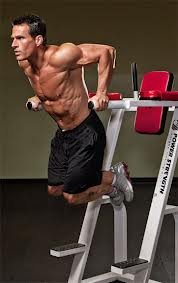
Parallel Bar Dips – These are very good for working the inner and upper pecs when the lifter’s hands are at shoulder width. Placed wider, the outer pecs and delt-pec tie-in are involved.


Dumbbell Exercises for a Chest Workout – Dumbbells may be used for a number of bench exercises that closely approximate the Olympic bar lifts. They may also be used to perform flies on a flat, incline or decline bench. These are good for stretching the pecs and ripping them up.


Cable-And-Pulley Machine – This device is good for chest finishing exercises like the two-handed crunch, where the exercise begins with arms spread wide and then the handles are brought together in front of the chest, with the arms slightly bent at the elbow.


Bent-Arm-Pullover - This move is performed on a flat bench with the weight on the floor. The lifter assumes a supine position and reaches back over his head for the barbell. Keeping his arms bent, the weight is brought to the chest in a circular motion.
A compound exercise is performed when the weight is then pressed from the chest as a close-grip bench press. The return is back to the chest and then lowered to the floor in a circular motion.
    
The best chest workout is to begin with the heavier weight exercises (bench press) and move “down the ladder” through the barbell exercises to the dumbbells and finally to the bodyweight resistance exercises to finish off the pecs.

Friday, 25 December 2015

How to Build Muscle Fast ???


The road to building muscle is a long and arduous one, but luckily some shortcuts have been discovered by the emerging science of sports physiology. These shortcuts can help you build muscle at a significantly faster rate than normal.

The first secret is that you don’t have to work each muscle for hours every day. In the (very) old school of bodybuilding, there was no way to build muscle fast. You hit the gym for three to four hours every day and worked your entire body every day.  At night you rested, and one day per week you stayed away from the gym.


In those early days, athletes in other sports were told to stay away from weight training because it would make them “muscle-bound” and inflexible.
But for whatever reason, more and more athletes began to ignore that advice and discovered that weight training actually made them stronger and actually more flexible.

This didn’t go past the notice of sports trainers who started to evaluate weight training for muscle building. Their affirmation of the advantages induced lots of sports trainers to add weight training to their fitness routines, and soon, football, baseball and basketball players, even track and field athletes, began to pump iron.

Sports physiology became a science and weight training began to receive a more scientific approach as applied to muscle building for athletes in all sports.
Bodybuilders took note and began to workout smarter, looking for ways to build muscle fast. They still spent long hours in the gym, but now it was about half the time they used to spend. Why were they able to do this?

Exercises and routines were evaluated for the best approach to building muscle faster, and bigger. Researchers found that it was important to rest muscles after they were worked strenuously; otherwise they become exhausted and cannot develop any further.

These days bodybuilders are advised to work each muscle group to total exhaustion only one day a week. Sure they get some exercise when you focus on other muscle groups, but that’s unavoidable. It is only on their “focus day” that they are exhausted. Using this strategy fast tracks your muscle growth and makes your body stronger overall.

You don’t need to put up with constant all-over muscle soreness every day of the week either, since muscle groups are allowed to rest, recover and rebuild themselves.
Another leap forward in bodybuilding was the discovery that working the muscle to total exhaustion for each exercise was sufficient to tear it down. The protein ingested by the bodybuilder would be mainly used to rebuild the tissue, rather than developing it even further.

The other side of the building-muscle-fast equation is good nutrition. It has been claimed that bodybuilding is 80% diet, and while this might not be entirely accurate, it certainly accounts for more than half.

To build muscle and build it fast, a bodybuilder’s diet must have at least 25% of its calories coming from both animal and vegetable protein. You should only eat of complex carbohydrates, particularly those vegetables that contain protein as well. Fats and fibers should also constitute about 25% of your diet. Avoid refined sugars, refined starches and minimal caffeine and alcohol. The diet should be supplemented with protein powders mixed with raw milk or water, protein boosters like desiccated liver, kelp tablets and eggs. A soluble oil like wheat germ oil helps the body metabolize protein and it will provide added endurance.

In sum, the path to fast muscle growth is about exercising each muscle group smarter, not harder. Rest is just as important as strength training, and eating a careful diet is most important of all.